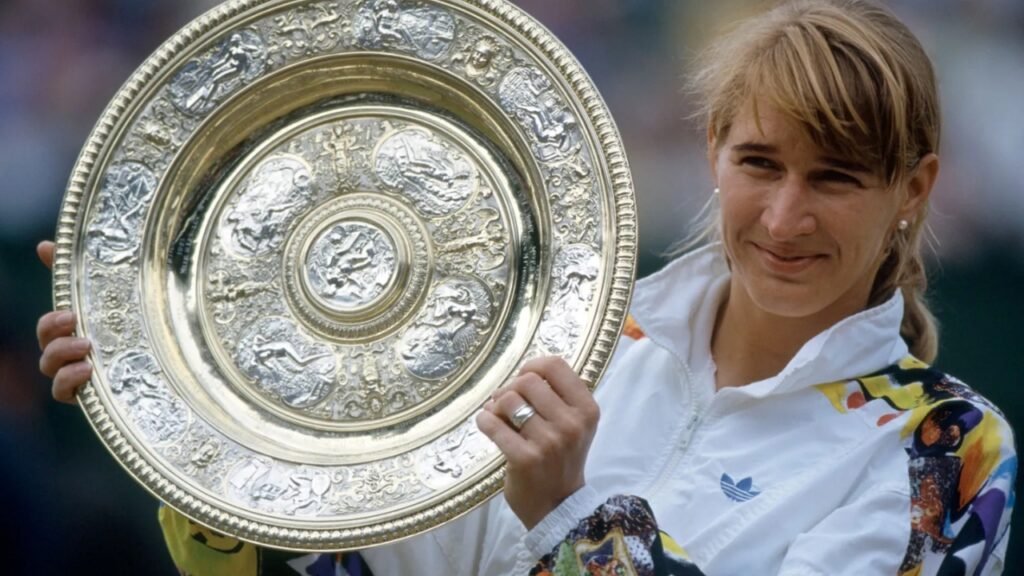
Hello, Tennis fans! If you love following the Tennis and admire world-class, Steffi Graf is a name you’ll recognize instantly. Steffi Graf is often cited as the gold standard of women’s tennis—a powerhouse who redefined the modern game with a lethal forehand and footwork that seemed almost supernatural. Even in 2026, over two decades after her retirement, her statistical dominance remains a benchmark that current players chase. Known for her “Golden Slam” in 1988—winning all four majors and an Olympic gold in a single calendar year—Graf’s legacy is not just in trophies, but in the sheer excellence she maintained over a 17-year career.
Steffi Graf’s Biography
| Category | Details |
| Full Name | Stefanie Maria Graf |
| Nickname | “Fräulein Forehand” |
| Date of Birth | June 14, 1969 |
| Age (2026) | 56 years old |
| Nationality | German |
| Height | 5’9″ (1.75 m) |
| Turned Professional | 1982 (at age 13) |
| Net Worth | $145 million |
| Spouse | Andre Agassi |
| Relationship Status | Married |
| Children | Son: Jaden Gil Agassi; Daughter: Jaz Elle Agassi |
| Instagram Profile | @stefaniegrafhq |
| Current Residence | Las Vegas, Nevada |
Early Career
Steffi Graf’s professional journey began in October 1982 at Filderstadt, Germany, where she lost in the first round to Tracy Austin. As the youngest player ever to compete in a Grand Slam main draw at age 13 during the 1983 French Open, Graf immediately signaled her extraordinary potential. Her father carefully controlled her schedule to prevent burnout, limiting her tournament appearances during her early years.
This conservative approach proved effective as her ranking climbed steadily from No. 124 in 1983 to No. 98 in 1983, No. 22 in 1984, and No. 6 in 1985. In August 1984, as the tournament’s youngest entrant at age 15, Graf competed in the tennis demonstration event at the Los Angeles Olympics. Though she failed to win titles during her first three professional years, Graf consistently reached finals and quarterfinals, demonstrating remarkable composure against established champions like Martina Navratilova and Chris Evert.
Her breakthrough moment arrived in April 1986 when she captured her maiden WTA title at the Family Circle Cup, simultaneously defeating Chris Evert for the first time—a victory she would replicate seven more times over the next 3.5 years.
Professional Career
Graf’s professional dominance crystallized during the remarkable year of 1987, when she claimed her first Grand Slam title at the French Open by defeating world No. 1 Martina Navratilova 6–4, 4–6, 8–6, immediately after beating Chris Evert in the final. This 1987 season saw Graf compile a stunning 75–2 record with a 97.4% winning percentage, with both losses coming against Navratilova. She overcame Navratilova’s 186-week reign at No. 1 on August 17, 1987, after winning the Virginia Slims of Los Angeles, holding the top ranking for 186 consecutive weeks herself—a women’s record matched only by Serena Williams decades later.
The defining year came in 1988 when Graf created tennis immortality by winning the Golden Slam, capturing all four Grand Slam tournaments and the Olympic gold medal in Seoul. Beginning with victory over Chris Evert at the Australian Open (6–1, 7–6), Graf continued with a 6–0, 6–0 demolition of Natasha Zvereva at the French Open—the most one-sided Grand Slam final ever played and the first double bagel in a major final during the Open Era. At Wimbledon, she dramatically recovered from 7–5, 2–0 down to beat Martina Navratilova 5–7, 6–2, 6–1, then defeated Gabriela Sabatini 6–3, 3–6, 6–1 in the US Open final. Finally, she beat Sabatini 6–3, 6–3 in the Olympic gold medal match, completing an unparalleled feat.
Throughout the 1990s, Graf’s career was marked by intense rivalry with Monica Seles, whose rise temporarily challenged her supremacy before Seles’s career interruption in 1993 due to a stabbing incident. Graf responded by winning 65 of 67 matches during Seles’s absence, claiming three of four Grand Slams and the year-end championships. Despite persistent back and knee injuries throughout the 1990s, Graf continued winning major titles through her 22nd and final Grand Slam victory at the 1999 French Open, when she remarkably defeated top-ranked Martina Hingis from a set down.
Husbend
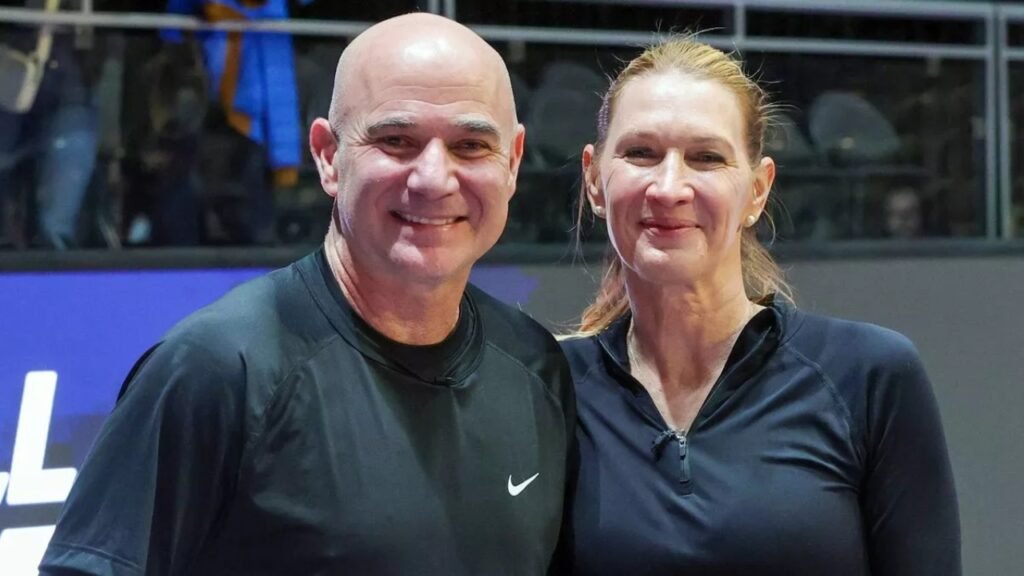
Steffi Graf married Andre Agassi on October 22, 2001, after meeting him on the professional tennis circuit and dating following the 1999 French Open. The couple kept their wedding intensely private, with only their mothers present as witnesses. Between 2001 and 2003, they welcomed two children: son Jaden Gil Agassi (born October 26, 2001) and daughter Jaz Elle Agassi (born October 3, 2003). Both children were born and raised in Las Vegas, Nevada, specifically in the Summerlin community. In their parenting philosophy, both Steffi and Andre have been explicit that they do not wish to pressure their children toward professional tennis, having witnessed the intense demands of competitive sports firsthand.
Jaden pursued baseball and signed with the University of Southern California, representing Team Germany at the 2025 World Baseball Classic Qualifiers. Jaz maintains a more private lifestyle, though she shares occasional family moments on social media. The couple continues to reside together in Las Vegas and remains one of tennis’s most enduring and respected partnerships, with their combined 30 Grand Slam titles representing an unmatched household achievement in the sport.
Steffi Graf’s Net Worth Details
As of 2026, Steffi Graf’s current net worth stands at approximately $145 million, a combined figure with her husband Andre Agassi, making them one of the wealthiest couples in tennis history. The substantial majority of this wealth stems from her extraordinary endorsement deals and business ventures rather than prize money alone. During her professional career, Graf earned a total of $21,895,277 in prize money—an astronomical sum for its era that would be equivalent to approximately $40 million in today’s dollars, though modern top players now surpass this figure during their careers.
Prize Money
| Tournament | Titles Won | Years of Victories | Grand Slam Status |
| Australian Open | 4 | 1988, 1989, 1990, 1994 | Hard Court |
| French Open | 6 | 1987, 1988, 1993, 1995, 1996, 1999 | Clay Court |
| Wimbledon | 7 | 1988, 1989, 1991, 1992, 1993, 1995, 1996 | Grass Court |
| US Open | 5 | 1988, 1989, 1993, 1995, 1996 | Hard Court |
| Career Grand Slam Titles | 22 | 1987-1999 | All Surfaces |
| Total Prize Money Earnings | $21,895,277 | 1982-1999 | Career Total |
| WTA Tour Titles (Non-Slam) | 85 | 1986-1999 | Career Total |
| Total Career Titles | 107 | 1982-1999 | Singles Titles |
Endorsements
Steffi Graf leveraged her unprecedented success to secure some of the most lucrative endorsement deals in women’s sports history. Throughout her playing career and beyond, she partnered with major global brands:
- Adidas – Her primary apparel and footwear sponsor throughout her entire career (1982-1999), and again from 2005 onward, earning her a custom signature shoe line during the 1990s
- Dunlop – Her exclusive racquet and clothing partner from the early 1980s through 1993, during which she used Dunlop racquets to win multiple Grand Slams
- Granini – A German fruit juice company that featured Graf as a prominent ambassador throughout the 1980s and 1990s
- Rexona – The antiperspirant brand maintained a long-term sponsorship relationship with Graf during her competitive years
- Teekanne – The German tea company featured Graf in extensive advertising campaigns across Central Europe
- Citibank – Major financial services sponsorship supporting her throughout the 1990s
- Danone – The multinational food corporation secured Graf as a brand representative for their yogurt and dairy products
- Barilla – The Italian pasta company partnered with Graf for international marketing campaigns
- Apollinaris – The German mineral water brand utilized Graf’s image for brand promotion
- Longines – The prestigious Swiss watchmaker appointed Graf as an official ambassador, a partnership that continued into her post-retirement years
- Kerala Tourism/Ayurveda – Graf served as brand ambassador for Kerala State in India and promoted Ayurveda wellness practices in North America, diversifying her endorsement portfolio into the wellness sector
Career Records
| Rival | Head-to-Head Record | Matches Played | Win Percentage | Notable Victories |
| Monica Seles | 10-5 | 15 | 66.7% | 1992 Wimbledon Final (6-2, 6-1); 1995 US Open Final; 1996 US Open Final |
| Gabriela Sabatini | 29-11 | 40 | 72.5% | 1988 US Open Final (6-3, 3-6, 6-1); 1991 Wimbledon Final (8-6 3rd set); Multiple clay court victories |
| Arantxa Sánchez-Vicario | 28-8 | 36 | 77.8% | 1994 Australian Open Final; 1995 French Open Final; 1996 French Open Final |
| Martina Navratilova | 9-4 | 13 | 69.2% | 1987 French Open Final (6-4, 4-6, 8-6); 1988 Wimbledon Final; 1989 US Open Final |
| Chris Evert | 8-0 | 8 | 100% | Never lost to Evert after 1986 Family Circle Cup breakthrough win |
FAQs
1. What is the “Golden Slam” and why is Steffi Graf the only player to achieve it?
The “Golden Slam” refers to winning all four Grand Slam tournaments (Australian Open, French Open, Wimbledon, and US Open) plus the Olympic gold medal in a single calendar year. Steffi Graf achieved this in 1988 at age 19, remaining the only player in tennis history—male or female—to accomplish this feat. The reason no other player has matched this achievement lies in its extraordinary difficulty: it requires winning on three different surfaces (clay at the French Open, grass at Wimbledon, hard court at the Australian and US Opens) in quick succession while maintaining peak fitness and mental focus across eight weeks and approximately 28 Grand Slam-level matches.
2. How many weeks did Steffi Graf hold the world No. 1 ranking, and does anyone else have a higher record?
Steffi Graf held the world No. 1 ranking for a record 377 weeks across her career, including 186 consecutive weeks from August 1987 to March 1991. This remains the all-time women’s record. Serena Williams tied her consecutive weeks record of 186 weeks in 2016, but Graf’s total of 377 weeks across her career remains unmatched by any female player. Among male players, Novak Djokovic has surpassed both with 428 total weeks at No. 1, but Graf’s record stands as the benchmark for excellence in women’s tennis.
3. What was Steffi Graf’s playing style and why was she called “Fräulein Forehand”?
Steffi Graf’s playing style was built around exceptional athleticism, aggressive baseline play, and a devastating forehand drive that revolutionized women’s tennis. She pioneered the modern power-baseline game, combining quick footwork with an aggressive mindset to hit through opponents rather than construct points. The nickname “Fräulein Forehand” (German for “The Lady Forehand”) originated from tennis commentators who marveled at her ability to strike forehands at extreme angles and pace that most opponents couldn’t handle. Unlike the serve-and-volley style dominated by Martina Navratilova, Graf’s game emphasized offensive groundstrokes from the baseline, a style that modern tennis evolved toward and that current players like Serena Williams and Iga Świątek have perfected.
4. How did Monica Seles’s stabbing incident in 1993 affect Steffi Graf’s career?
In April 1993, Monica Seles was stabbed between the shoulder blades by a mentally ill fan of Steffi Graf named Günter Parche. Seles missed over two years of competitive tennis as a result. While the incident was unquestionably tragic and deeply disturbing, it had significant ramifications for Graf’s career: during Seles’s 27-month absence (1993-1995), Graf won 65 of 67 matches, claimed three of four Grand Slam tournaments, and reasserted her dominance on the women’s tour. Some analysts argue that Seles, who had reached world No. 1 in 1991 at age 17, might have prevented Graf from winning additional major titles had she remained healthy. When Seles returned in 1995, Graf defeated her in the US Open final and maintained her competitive edge, though the rivalry was arguably less dominant than it might have been.
5. What is Steffi Graf’s relationship with her Children for Tomorrow foundation?
Steffi Graf founded Children for Tomorrow in 1998 (some sources cite 1999), a nonprofit organization dedicated to providing psychological and medical support to children traumatized by war, violence, abuse, and family separation. The foundation operates in conjunction with the Outpatient Clinic for Refugee Children and their Families at the University Clinics of Hamburg-Eppendorf in Germany. Graf serves as founder and chairperson of the board, maintaining direct involvement in the organization’s operations and making regular personal financial contributions. The foundation reflects her humanitarian values and commitment to using her platform and wealth to address global suffering, particularly affecting vulnerable children. She has donated exhibition match proceeds to the foundation and participated in benefit events to raise awareness and funding.
6. Why did Steffi Graf retire in 1999 despite being ranked world No. 3?
Steffi Graf retired in August 1999 at age 30, ranked world No. 3, with her motivation and passion for the sport significantly diminished. She cited multiple reasons: a loss of desire to compete despite still possessing the skill to win major titles, persistent injuries (back, knees, wrist) that required multiple surgeries, and a fundamental shift in her relationship with tennis. After reaching the 1999 Wimbledon final (which she lost to Lindsay Davenport), Graf felt the competitive fire had extinguished. She famously stated: “I have done everything I wanted to do in tennis. I feel I have nothing left to accomplish.” Rather than decline as a player, she made the courageous decision to retire while still competitive, preserving her legacy at its highest level.
7. How did Steffi Graf’s 1988 season compare to other dominant tennis seasons in history?
Steffi Graf’s 1988 season remains arguably the greatest tennis season ever achieved. She compiled a record of 77–3 (96.3% winning percentage), including a 28–0 record in Grand Slam matches, won six titles that year, claimed all four Grand Slams without dropping a set at the French Open, and won the Olympic gold medal. Only four other players have posted comparable seasons: Serena Williams (88% win rate in 2015), Roger Federer (88% in 2006), and Novak Djokovic (multiple seasons exceeding 85%). However, Graf’s feat remains distinctive because she accomplished it on three different surfaces during an era when the game was arguably more physically demanding, as surfaces were slower and rallies longer than in the modern era.
8. What is Steffi Graf’s legacy in modern women’s tennis?
Steffi Graf’s legacy fundamentally changed how women’s tennis is played and perceived. She introduced the aggressive power-baseline game that has become the dominant style in modern tennis, influencing players from Venus Williams to Serena Williams to contemporary stars. Her longevity at the highest level (winning Grand Slams across three decades from 1987-1999) established a template for sustained excellence. Beyond tactics, Graf elevated women’s tennis’s global profile, particularly in Germany where she and Boris Becker popularized the sport. She demonstrated that female athletes could be dominant, marketable, and influential beyond the sport itself. Her focus on business ventures post-retirement (rather than simply fading from public life) created a blueprint for female athletes’ post-career financial success. Finally, her humility, sportsmanship, and charitable work redefined what it meant to be a champion, emphasizing responsibility to society alongside competitive achievement.
9. How does Steffi Graf’s 22 Grand Slam titles rank historically, and has anyone surpassed her?
Steffi Graf’s 22 Grand Slam singles titles rank third all-time in women’s singles tennis, behind Serena Williams (23) and Margaret Court (24 in the Open Era, 64 in her entire career including Pre-Open Era). In the Open Era exclusively, Graf’s 22 titles are the second-most after Serena. What distinguishes Graf’s achievement is that she won these 22 titles across four different tournaments, with at least four victories at each major—a quadruple career Grand Slam that no other female player has achieved. She also maintained the highest winning percentage at Grand Slams (90%), suggesting that her consistency and dominance on the game’s biggest stages may have been unmatched.
10. What are Steffi Graf and Andre Agassi’s current activities in 2026?
As of 2026, Steffi Graf and Andre Agassi remain married and reside in Las Vegas. Though both are retired from competitive tennis, they remain active in various capacities: Graf continues her work with Children for Tomorrow foundation, makes occasional public appearances, and serves as a commentator or analyst for major tennis events. She appears sporadically on Instagram through @stefaniegrafhq, sharing family moments and nostalgic tennis content. The couple supports their adult children (now 24 and 22) and remains respected figures in the tennis community. They have shown interest in charitable endeavors and speaking engagements, leveraging their combined platform to address social issues and inspire younger generations. Recently, they welcomed a new pet (a dog named Copper) to their family, which they shared on social media, indicating they maintain an active lifestyle together in retirement.